
[category]
[title]


Review

Yes, there’s some Star Wars to see at the Lucas Museum of Narrative Art, but that’s only a small slice of the collection at this spaceship-like Exposition Park institution. More than 1,300 genre-hopping figurative works are on display in the near-instantly-iconic landmark, with galleries, gardens and a striking library that are all home to filmmaker George Lucas and businesswoman Mellody Hobson’s personal collection. Though the presentation of the artwork may leave you with questions about curation and context, the overall experience is wholly worthwhile and, for better or worse, unlike any other museum.
Pitched as a temple to “the people’s art” and an illustrated showcase of storytelling, the Lucas Museum is stocked with the sources of imagery you’ve seen in decades’ worth of book covers, magazine spreads, newspaper pages and films: It houses artists like Norman Rockwell and N.C. Wyeth as well as recognizable ink drawings from comic strips like Peanuts and Garfield plus genre pioneers like Jack Kirby and Frank Frazetta. Aside from the intro gallery to narrative art on the ground floor and a lofty mural space on the fifth (that includes a surprise assembly of Banksy pieces), the rest of the holdings reside on the fourth floor, broken up by theme (motherhood, community, sports), genre (fantasy, adventure, science fiction) or artist (Maxfield Parrish, Jessie Wilcox Smith, Thomas Hart Benton).
At the center of the floor, the Cinema gallery debuts with a display of Star Wars vehicles (including Anakin’s podracer, Luke’s landspeeder and General Grievous’s wheel bike), costumes (Darth Vader, Princess Leia, Boba Fett) and screen-used miniatures (including the Millennium Falcon and an AT-AT and AT-STs). But Star Wars diehards should know: Outside of these and a few bronze sculptures in the garden, this is not a Star Wars museum; the saga only comprises about 7% of what’s on display here.
Speaking of those gardens, they’re just stellar and extraordinarily transportive. Mia Lehrer and the team at Studio-MLA have turned what was once a parking lot into grassy expanses and meandering walking paths that are open to the public—no museum ticket needed. You’ll find a shallow amphitheater at the gardens’ southern end and sculptures dotting the landscape, including ones of Rosie the Riveter, King Kong stop-motion animator Willis O’Brien and, uh, Jabba the Hutt being strangled by Leia.
The white, cloud-shaped museum building, designed by Ma Yansong of MAD Architects, just might mark the quickest a building has become a local landmark. From outside its perimeter, it appears to float above the park. From within its plaza, it arches towards the sky, which peeks through its oculus. Its grand lobby—with twin cinemas, a cafe and gift shop attached—feels straight out of a retrofuturistic spaceport, with circular glass elevators ferrying visitors up to the galleries. (You may encounter a queue to use them during busy periods.) The views from the rooftop—including its practically-impossible-to-book restaurant—are postcard-worthy, as are the flowers that carpet the sloping top of the structure.
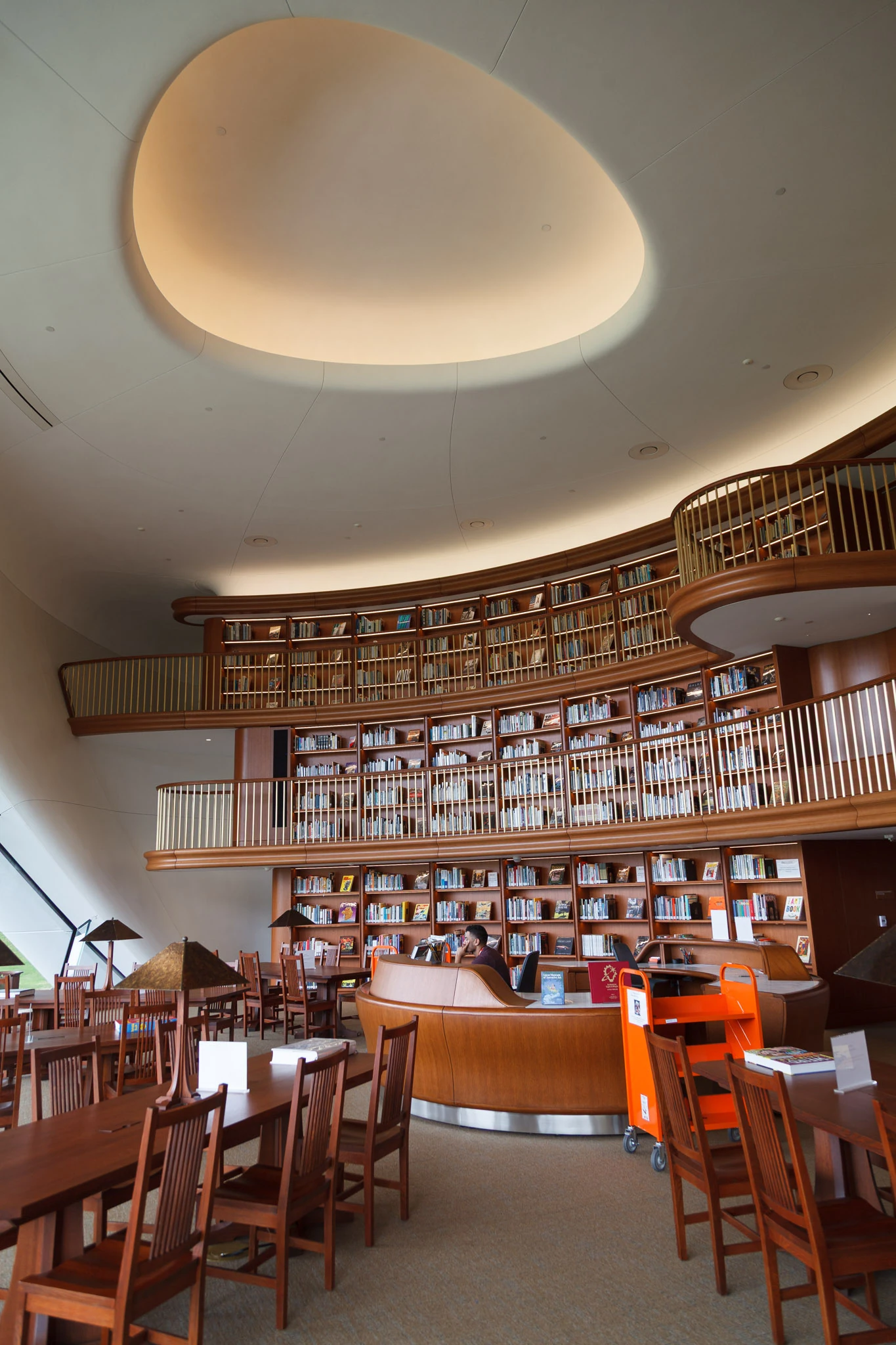
Architecture and community-facing resources work their perfect alchemy together at the superb free-to-visit research library, where light streams through the sci-fi shell and into a warm, Arts and Crafts–style sitting area with three floors of shelves carrying art books on everything from paleoart to Renaissance warfare to the X-Men.
So maybe it’s because I love so many standalone portions of the museum that I find myself exasperated by its shortcomings. We should celebrate an institution that makes unlikely neighbors of a self-portrait of Frida Kahlo, an oil painting of dogs playing poker and a screen-used Batman suit—but there’s no attempt made at explaining why these all deserve equal weighting in the vaguely-defined world of narrative art. Aside from reflective gallery titles and small artwork identifiers, there’s zero wall text here. That means if you’re not already familiar with Frank Frazetta’s impact on modern fantasy illustrations, you might wonder why you’re surrounded by walls of buff, barely-clothed bodies that belong on a van mural. (Women are most often mothers or buxom babes across the collection.) Showing is certainly better than telling when possible: In the sprawling Rockwell gallery, a famous painting of a police officer and a runaway boy sits next to Richard Williams’s contemporary parody of a militarized officer hulking over a young Black boy. But this sort of cross-piece conversation is rare outside of here.
The lack of context means the museum is most successful when it makes you feel something. For me, that happens to be in the wonderful children’s illustration gallery, where original drawings of Babar, Little Bear and Winnie the Pooh make my heart melt. But maybe for you, that’s Maxfield Parrish or Jessie Willcox Smith (the only woman with an artist-focused gallery)—I wish the museum could furnish any sort of framing here.
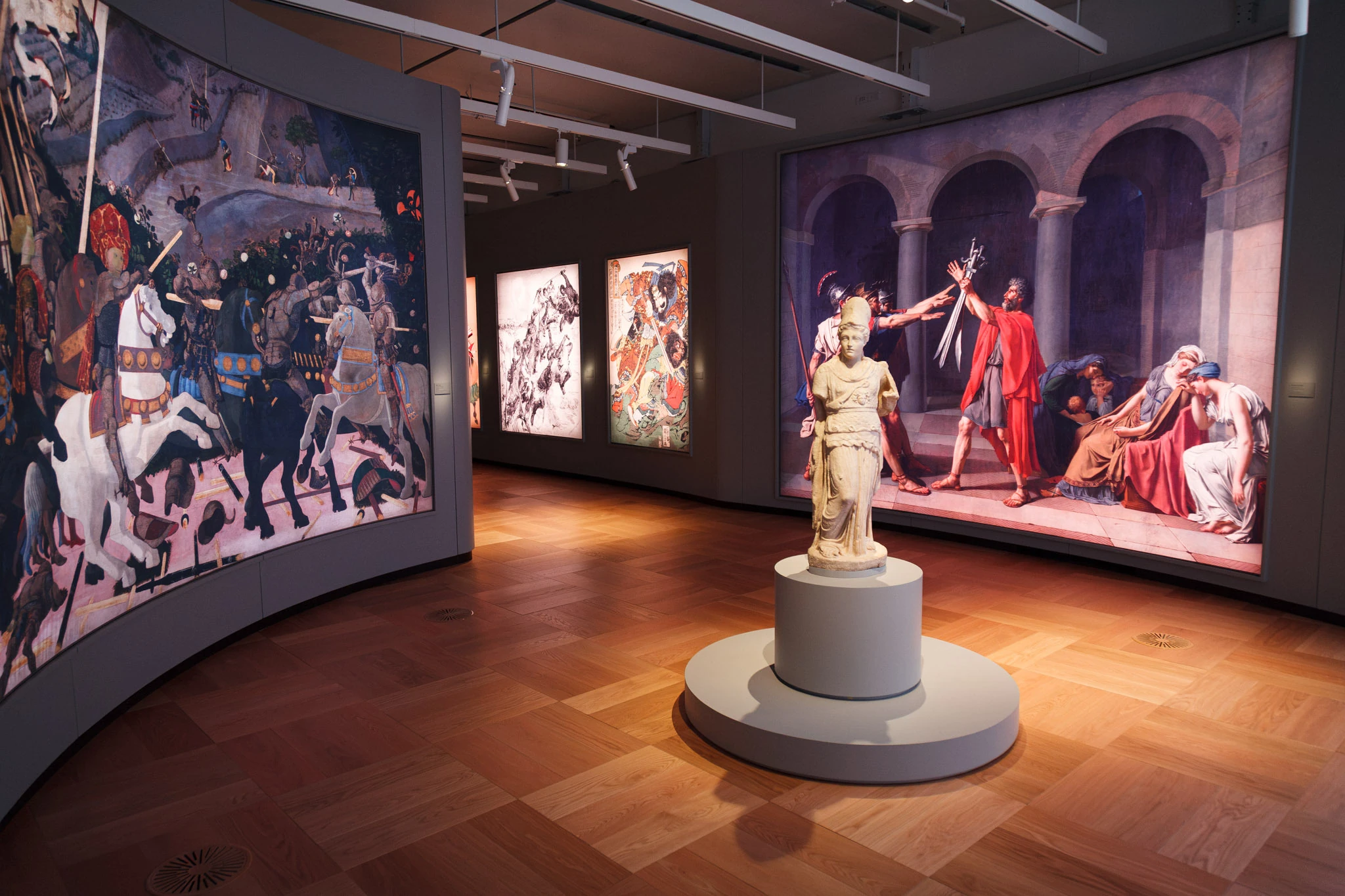
That information gap really hampers the ground-floor myth gallery, an Immersive Van Gogh–like assembly of works from across continents and millennia that tries to save you the trip to Europe by re-creating masterpieces as slick 3-D-esque porthole displays or illuminated canvases. But there are some original pieces mixed in among the reproductions if you look closely, which might then leave you scrutinizing the very-real pieces on the fourth floor.
Well, mostly very-real: A handful of the Star Wars costumes and vehicles are contemporary reproductions rather than screen-used originals, and the exquisite concept art from Ralph McQuarrie and Doug Chiang that lines the gallery entry are blown-up prints (which offer better visibility than their smaller originals). It does raise some interesting questions about reproductions: Is it more important to be in the same room as something the artist’s hand touched? Or to simply be exposed to the artist’s intent? Is that much different from a framed photograph? Or the already-much-loved print of Naoyo Kimura’s Van Gogh–style portrait of Pikachu, which otherwise solely exists as a piece of digital art?
There’s a lot on display here—almost exclusively of faces staring back at you—that could be edited down to tell a more concise story of the “what” or “why” of narrative art. Or maybe, if the museum is ultimately an expression of Lucas’s personal tastes, they could tell us more about how one of cinema’s most influential storytellers synthesized elements of old myths to tell something new. With more than 40,000 pieces in the collection, we can only hope that the galleries’ next iteration will have a new story to tell.
Discover Time Out original video