Thanks for subscribing! Look out for your first newsletter in your inbox soon!
The best of Bangkok straight to your inbox
We help you navigate a myriad of possibilities. Sign up for our newsletter for the best of the city.
By entering your email address you agree to our Terms of Use and Privacy Policy and consent to receive emails from Time Out about news, events, offers and partner promotions.
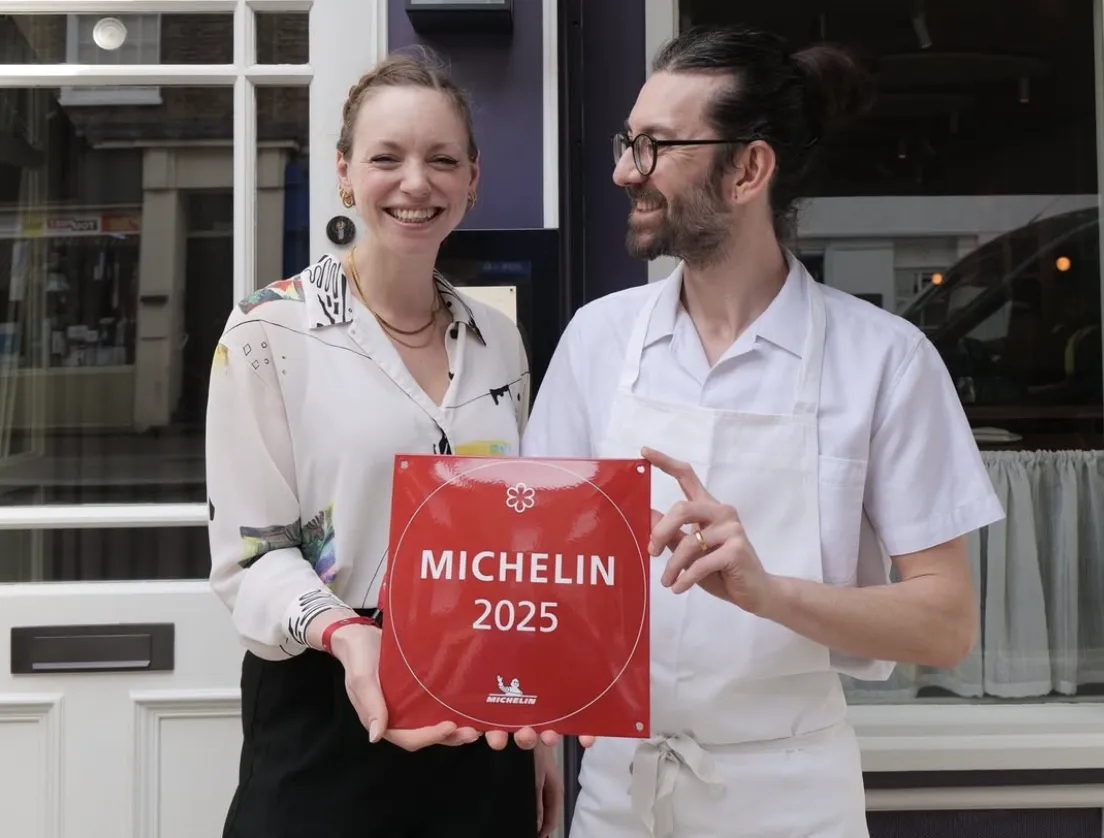
Thai-British chef John Chantarasak is sitting at the back of the ceremony hall in Glasgow at the Michelin Guide Ceremony 2025, 'stomach in knots, looking around, seeing every Michelin-starred chef in the UK is here.' One hour of preamble before they start calling names.
Just 10 days ago, he got an email. Stark, giving nothing away but unmistakably Michelin – an invitation to the ceremony with a plus-one. He’d called his wife, Desiree, immediately.
‘We need tickets to Glasgow. Holy shit. Maybe we’re winning a star.’
Photograph: AngloThai
AngloThai is now London's only Michelin-starred Thai restaurant.
‘You hear your name and it’s a very surreal moment,’ he says now. ‘When I first started cooking, the dream was to open a restaurant. We achieved that. Winning a Michelin star felt like an unattainable thing we should always pursue. But it was really the icing on the cake.’
Processing it took longer than expected. In the aftermath, John got a bit lost.
‘We’d spent so much time and effort trying to open and then we won the star and I was like, well, what happens now? I’ve kind of done all this stuff and I’m confused.’
That moment lasted a couple of days before clarity returned. You keep getting better. You make the restaurant better every day. Maybe one day you push for another star.
‘I think that’s a good thing, to always have a target in mind.’
But leading to this there was a guy playing music in a Welsh village, who’d taken an economics degree, who’d worked in the city for two years feeling not quite right and who’d bought a ticket to Bangkok because at least here he could eat well while figuring things out.
The last roll of the dice
Photograph: Englishhippie
The shift from music to cooking was ‘a very creative style of applying yourself. There's not necessarily a rulebook. You kind of have to hustle a bit and find your own path.'
John spent his teenage years in a band with close friends, chasing music with the kind of hunger that only exists when you're young and all in.
But the music fizzled out. The economics degree led to the city job. The city job led to the road trip across America, moving from place to place based on restaurant recommendations and food blogs, feeling something click into place that hadn't clicked before.
'I was a bit older when I moved to Bangkok. I was 27. And truth be told, I think it was almost the last roll of the dice of being able to do something creative with my life.'
Photograph: AngloThai
'I always knew I liked food. But I never imagined I was going into hospitality – owning a restaurant.' UK-raised with a Thai father and English mother, he'd return to Thailand most years, keeping that connection intact.
So he enrolled at Cordon Bleu Dusit in Bangkok. Quit drinking for 18 months. Lived alone. Focused.
'It was quite a solitary existence, but it was a really pivotal moment. There was massive focus on just trying to make this happen. And once I started, I loved it straight away. I found out I was pretty good at it.'
He started working in restaurants and eventually landed at Nahm, David Thompson's Bangkok outpost, the restaurant that had originally opened in London before Thompson moved the whole operation to Thailand, disillusioned by the difficulty of sourcing proper ingredients in the UK.
'I was only there for a couple of months, but it was very eye-opening seeing Thai food cooked in that way. I'd never seen it like that before.'
Advertising
How to make Thai food without Thai ingredients
Photograph: AngloThai
By the time John moved back to London and started working in Thai restaurants there, he had an itch. Not quite a plan. Just the sense that he wanted to do something of his own, express himself somehow, though he didn't know what that would look like.
The first pop-up that became the DNA of AngloThai happened in 2015. A friend invited him to cook at his modern British restaurant and John initially planned a very typical Thai menu. But the chef-owner challenged him.
'He was like, do we have to use all these ingredients that we don't really know where to source from or import? What's the flavour profile? Can we substitute it for something else?'
That was the lightbulb moment.
Photograph: AngloThai
'Thai food for me was very much about four flavours synonymous with the cuisine: sweet, spicy, salty and sour. And you can actually achieve those flavours from different ingredients that aren't necessarily the ones used domestically in Thailand.'
So they started using British produce. Yorkshire rhubarb juice instead of lime. Sorrel in place of sour leaves. Summer chillies grown in the UK, then dried and preserved for winter curries, the way you'd do in Thailand if you didn't have access to fresh chillies year-round.
'In Thailand, you have access to fresh chillies 365 days a year, so something like green curry can be made at any point. But in the UK, we should only really have access to fresh chillies during summer. So we make fresh-style chilli pastes for curries in those months and we preserve the darker red chillies for winter when they're not growing.'
It's not 'how do I get Thai ingredients to London' but 'how do I find these flavours where I am'.
Advertising
Oh…Michelin had been in
Photograph: AngloThai
Many pop-ups followed. Flying around the world, testing menus, working out what the concept actually was. Meeting winemakers across Europe with Desiree, who'd left graphic design to study wine and become a sommelier.
By the time they opened in November 2024, they had a clear picture: 'We definitely felt like we had a very clear picture of what we were doing. It wasn't just, oh, we're going to open a restaurant and muddle our way through.'
Still, they didn't know if they'd be on Michelin's radar at all.
But friends who had stars told him something useful: November was the last month you could possibly open if you wanted Michelin to consider you for the February ceremony in the UK. They make all decisions by the end of November. December's a write-off. January's too late.
Photograph: AngloThai
'We felt like we could win a star, but I thought it would be this February coming. Three months in was probably too much of a hope.'
They got added to the guide in January. No accolade, but confirmation that Michelin had been in. Then, 10 days before the ceremony, John got that email inviting him to Glasgow with a plus-one.
The 10-day run-up was agony. Stomach in knots. Couldn't stop thinking about it. At the ceremony, every Michelin-starred chef in the country was there, all the people John had looked up to his whole career.
'I really didn't want to presume until they called us up. And thankfully we were the third restaurant they called to the stage.'
There was an hour of preamble before they started calling names. John felt sick the entire time. Desiree burst into tears. They were sitting right at the back of the ceremony hall – ‘too nervous to sit any closer.’
With all said and done, Pop-ups remain part of the brand's DNA. Most recently (January 2026), John brought AngloThai to Bangkok, doing a four-hands dinner at 80/20 with head chef Thav, who he's known since Thav cooked in London.
Advertising
No à la carte in these parts
The restaurant itself is intimate – 44 seats in West Central London, walking distance from Oxford Street and Hyde Park. They do nearly 100 covers a day between lunch and dinner, which is a lot for the space. The dining room is named AngloThai. Downstairs is Baan, the private room that seats up to 16, named after the Thai word for home.
Photograph: AngloThai
It’s the only Thai restaurant in London working exclusively with tasting menus, not à la carte. John initially tried running both formats but quickly realised it wasn’t operationally sustainable.
'After two months, we pivoted to only tasting menus. Everything became easier to manage, especially with rising costs of labour and food. All the overheads in London are pretty eye-watering at the moment.'
There's another reason, though. John genuinely believes Western diners still misunderstand how to eat a Thai meal.
'You need a sequence of different-style dishes. You need balance across the whole menu. In à la carte Thai restaurants, people order very unbalanced meals. They're not experiencing Thai food in the best way. We had more control going down the fine dining route.'
Advertising
The 'kanom dok jok' cracker
Photograph: AngloThai
The menu changes constantly. They've done something like 100 dishes in the last 18 months. Only one dish has never changed: a crab, caviar, coconut situation that's become the restaurant's calling card.
John takes whole crabs, picks down the sweet white meat, then works with the brown meat separately. The white meat gets dressed in fresh coconut cream with chilli, mackerel, coriander root, galangal, seasoned with honey and their house-made fish sauce. They pack it into a small ramekin, cover it with British caviar infused with Welsh seaweed and Thai long pepper, then serve it in a bowl of ice.
On the side: a jet-black kanom dok jok cracker, the traditional lotus-shaped Thai cracker made with a brass iron dipped in batter and fried. But they've put ash powder from coconut husks into the batter, turning it completely black. The cracker gets filled with an emulsion made from the cooked brown crab meat and coconut cream, then dotted with elderflower vinegar gel for sharpness.
'It's quite a striking appearance,' John says, which is the understatement of the interview. 'When we opened, that was the dish everyone was taking photos of and putting on Instagram. It became the dish everyone wanted to come and try. It would be very difficult to move it from the menu now.'
No rice – 'Controversial, I know.'
Everything else rotates with the seasons. Which brings us to the other thing: AngloThai doesn't serve rice.
'Controversial, I know.'
Instead, they work with one supplier who sources heritage ancient grains from UK farms. Things like emmer, a bit like spelt. Farro. Whole grain naked oat, which tastes a bit like brown rice. Barleys. They steam them in a rice cooker sometimes, or cook them in kombu stock and stir-fry them with confit duck leg, depending on what's on the menu.
Advertising
Photograph: AngloThai
'There's plenty of Thai restaurants cooking much more authentic Thai food and serving rice from Thailand and that's great. But we just want to be different. It makes more sense to champion these heritage grains and talk to people about them. We know the farmers' names. We go to the farms. Our guests are very interested in the storytelling and the provenance.'
In the early days, older guests would come in and register mild shock. Not serving rice at a Thai restaurant felt taboo. But John's laid his bed and he's sleeping in it.
'We only import coconuts from Thailand because there's no real substitution for that. We explored making a pulse-based milk, like soy milk, but it felt wrong cooking out a curry and seasoning it with chickpea milk or something. It just didn't feel right.'
Southern spice and the Eastern aunties
Photograph: AngloThai
The menu pulls from all regions of Thailand, though John admits he leans a bit more into southern-style dishes lately. He likes the spice, the coconut cream, the seafood focus.
'Northern and Isan food is more earthy and funky, not necessarily the flavours people commonly associate with fine dining.' Though they've served an Isan-style keng om with lamb before, seasoned with fermented fish sauce and finished with fresh dill. Mind-bending for most diners. But that's the point.
'We're here to expose people to Thai food in its real nature.'
Right now, John's particularly interested in eastern Thai food. He's just come back from four days in Chantaburi and Trat, cooking with aunties in family homes, getting told everything he was doing was quite wrong, collecting recipes that'll hopefully hit the menu when he's back in London next month.
'As far as I'm aware, very few people globally are cooking eastern Thai food. I think the only reference point I've had is Sri Trat in Bangkok. It's a relatively unknown part of the world.'
Advertising
Weaknesses are fun
John didn't really feel naturally comfortable with pastry, but 'You kind of have to identify your weaknesses and work at those. Otherwise you're always going to be with it.'
The vegan menu was another challenge John took on, something he didn't feel comfortable with initially but knew he needed to learn. They've picked up accolades for it since, been listed among restaurants that are fully vegetarian or vegan-focused.
Photograph: AngloThai
'Every review from someone with that dietary preference has been positive. A lot of the dishes have to be completely different from the regular menu. You can't make a vegan keng om because the identity is fermented fish sauce. You have to lean into a different dish completely. It's more work, but it's nice when you can be really proud of what you're producing.'
Advertising
The five-to-10-year plan
The long-term vision, if they make it to that milestone, is to become even more self-sufficient. They're already making garum-style fish sauces from vegetables and meat products, not just fish. They're working with a nearby brewery that makes koji from British grains and they're in early conversations about holding onto seafood waste to eventually produce their own fish sauce.
Photograph: AngloThai
'It probably wouldn't just be our restaurant at that stage. If we can do that, it would make sense to supply other restaurants to split the cost. But yeah, it's going to be a slow burner for sure.'
Advertising
John's Bangkok favourites
Samrap Samrap Thai is his favourite restaurant in the whole city, hands down. He's eating there tonight, in fact, half an hour after this interview.
Baan Lamyai is his new discovery on this trip, a small restaurant run by a female chef in her grandmother's transformed condo inside a tower block.
For more casual eating, there's Soei near Chatuchak, a mom-and-pop spot he returns to often.
Also, he wants to try Ōre, the Greek chef's 25-30 course tasting menu done in one-bite portions using Thai produce, but probably won't have time this trip.
By entering your email address you agree to our Terms of Use and Privacy Policy and consent to receive emails from Time Out about news, events, offers and partner promotions.
🙌 Awesome, you're subscribed!
Thanks for subscribing! Look out for your first newsletter in your inbox soon!