[title]
Theater review by Adam Feldman
Rating: Not recommended
Ticketing: Buy tickets here
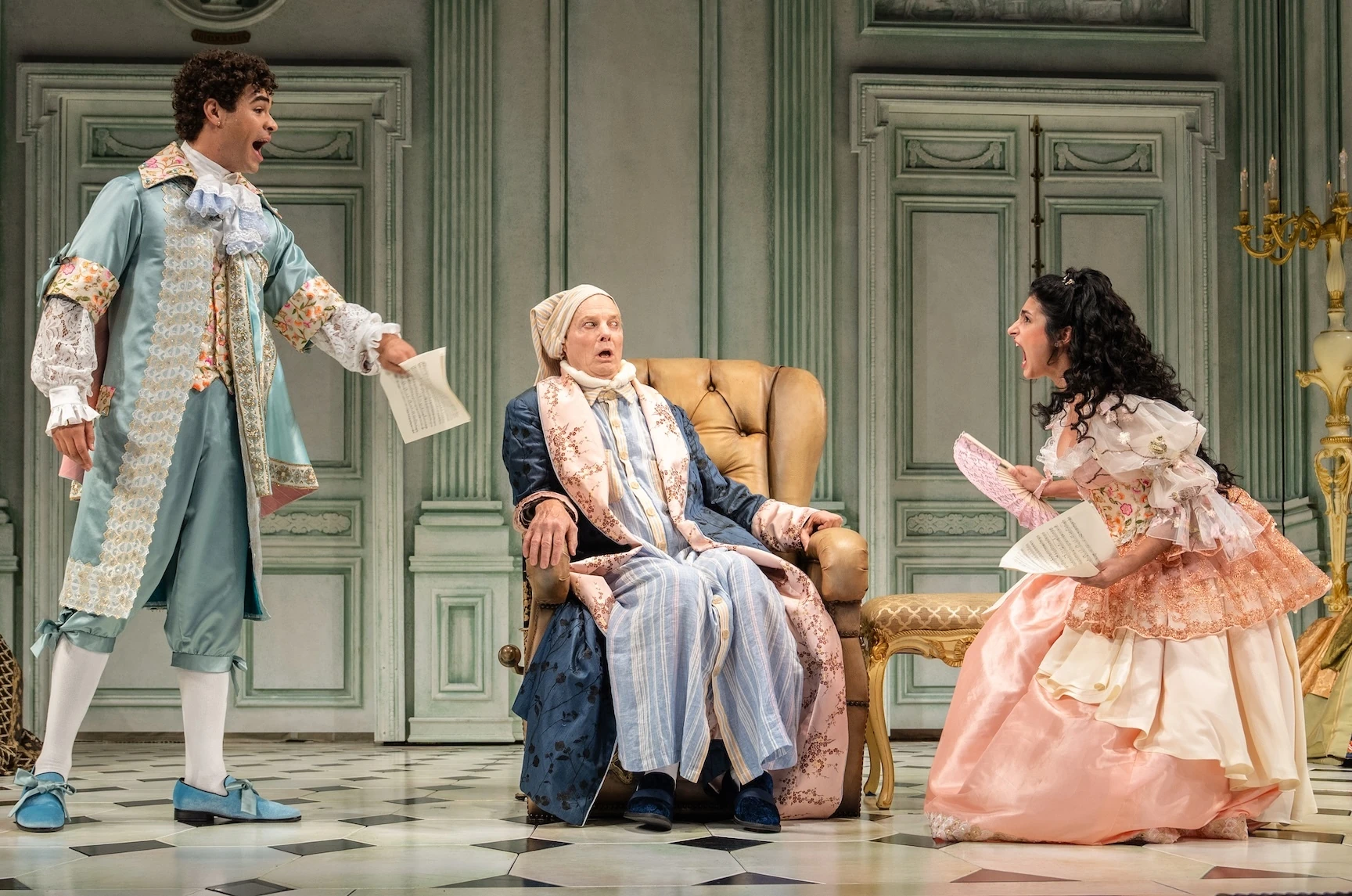
“I mean, do people actually laugh when they pay their good money and go to those plays of his?” says Argan, the rich hypochondriac of The Imaginary Invalid, in a swipe at the play’s own author, Molière. “I hear it is often very quiet in his theaters…” This metatheatrical dig proves all too apt in the context of the classic 17th-century comedy’s sweaty, wheezy Broadway revival, at which pained silence often greets the actors’ strained exertions.
The original French text does include a passage in which Argan attacks Molière, but not because his shows aren’t funny. That line of faux self-deprecation has been added by Bill Irwin, who has adapted and squeezed The Imaginary Invalid (in a translation by Doug Skinner) into the 85-minute version now playing at the Roundabout’s Todd Haimes Theatre. Irwin also plays the title role, as did Molière—who, as irony would have it, was fatally ill at the time and died shortly after his play’s fourth performance in 1673. (“If I were a doctor, I'd get my revenge for his impertinence,” he’d said of Molière when onstage as Argan. “And when he's sick, I'd let him die without help.” Perhaps his physicians took up that threat.)
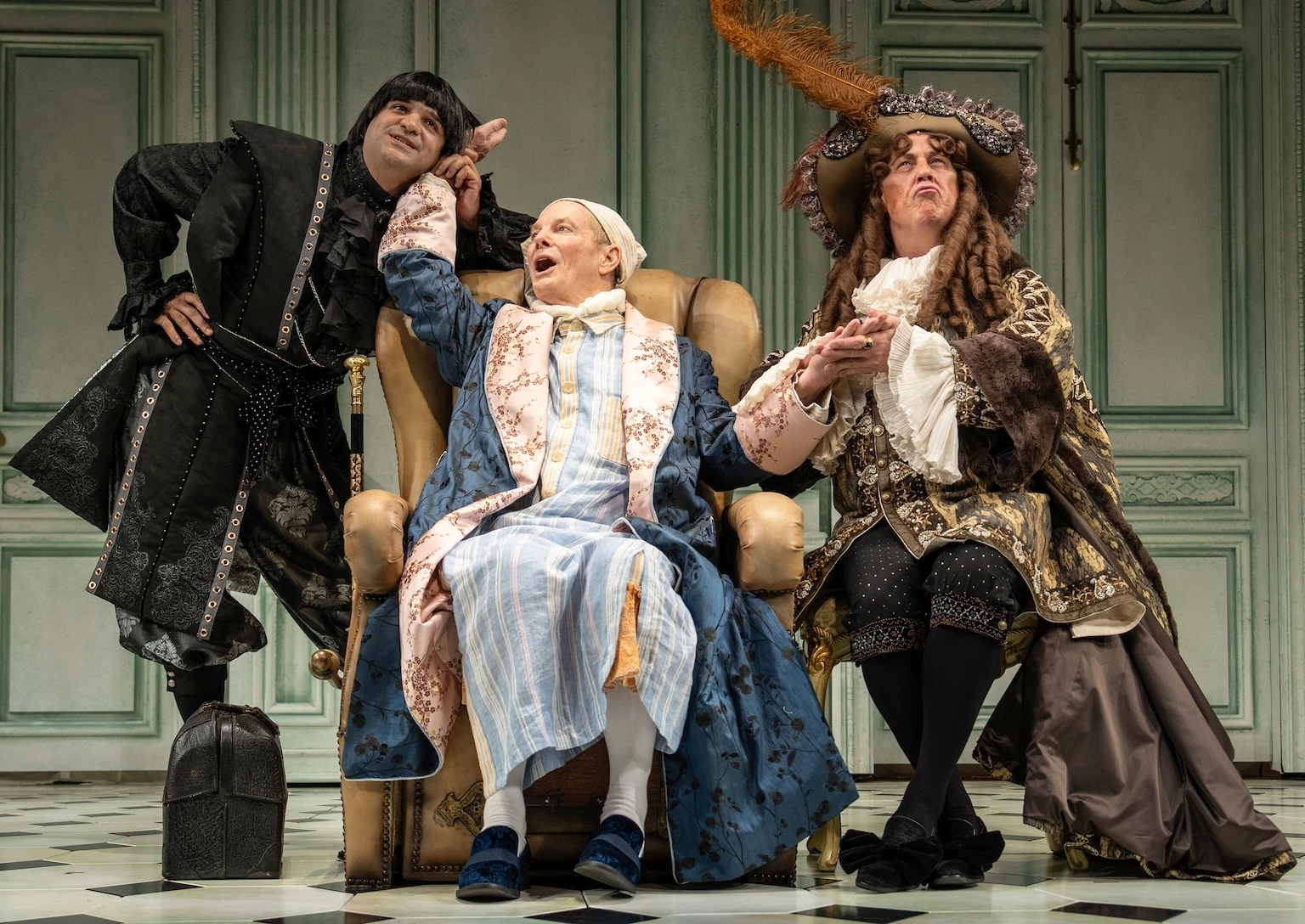
If this production fails to amuse, except in spurts, it isn’t the fault of Molière in general or even this play in particular: Off Broadway’s Red Bull Theater mounted an excellent account of it just last year, adapted by Jeffrey Hatcher and starring Mark-Linn Baker. The problem is that Irwin and director Brandon J. Dirden try to extend the play’s metatheatrical resonance into an organizing principle, and a message that, paradoxically, takes its own comedy very seriously indeed.
This production presents itself from the jump as Theatre with a capital T. A dumb-show curtain raiser places a masked Pantalone figure on an empty stage, holding a staff; at his summoning, the other performers—also masked, and wearing the black robes and white ruffs of commedia doctors—swarm about and draw symbolic red ribbons from his body. Only then do the walls and ceiling of Beowulf Borritt’s attractively rendered set arrive to take form as Argan’s parlor, as Irwin takes his place on a central recliner to do his business: sorting through a stack of medical bills. This should be a cakewalk for Irwin, a supremely gifted clown; instead, it feels rushed and fumbled (and mumbled). Irwin contorts his face into multiple comic grimaces throughout the show, modeling rictus after rictus with great skill, but his highly precise physical comedy seems out of step with the performances of the other actors.
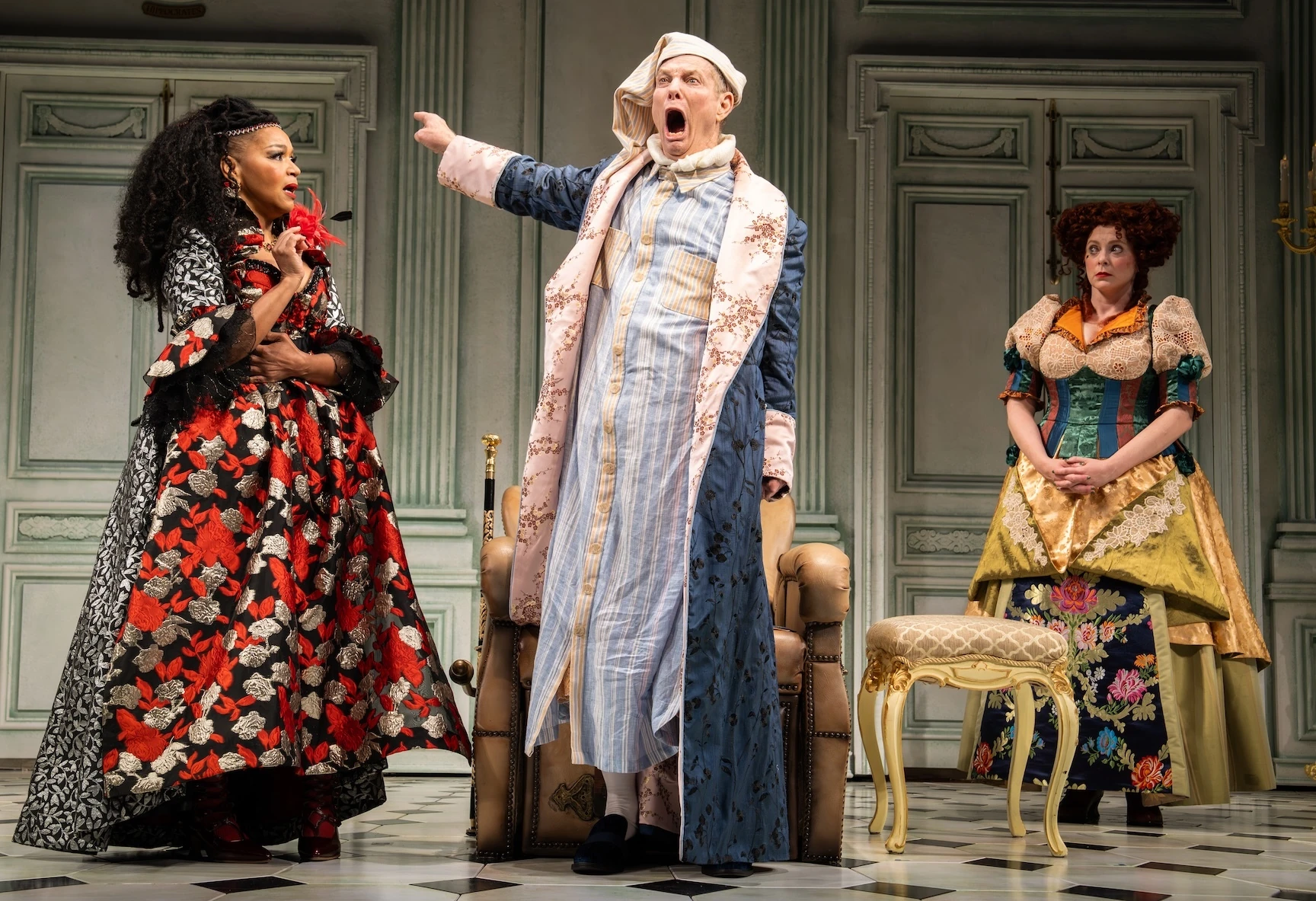
These include Crystal A. Dickinson as Argan’s scheming wife, Beline, and Dylan Baker as his sensible brother, Beralde; the fresh-faced and pretty-voiced Ava Lalezarzadeh and Daniel Croix Henderson as young lovers Angelique and Cleante; Brooks Ashmanskas as both Argan’s primary physician, the purgative-pushing Purgon, and pompous doc named Diafoirus; and Hiram Delgado in three roles, including Diafoirus’s moronic and brutally wigged son. Gussied up in extravagant costumes by Karen Perry, all of them have been directed to ham it up flamboyantly, and some of them get laughs in individual flourishes; but without a shared rhythm, they step on each other’s toes.
Rachel Bloom, in her Broadway debut, brings hints of inner life to the feisty servant Toinette, who urges Argan to defy his advisors and relax his reliance on laxatives. (The enemy of his enema is his friend!) Otherwise, the production embraces its own artifice with a self-regard worthy of a Molière protagonist. “A true healer knows this. Health is laughter,” says Beralde at one point; “It surpasses understanding. It is the theater,” he says at the end. Forget all the quacks, this play wants to say; the real doctor is right before your eyes, in this very room, as important and relevant as ever! But not all invalids, it turns out, are fabulous.
The Imaginary Invalid. Todd Haimes Theatre (Broadway). By Molière. Translated by Doug Skinner. Adapted by Bill Irwin. Directed by Brandon J. Dirden. With Irwin, Rachel Bloom, Dylan Baker, Brooks Ashmanskas, Hiram Delgado, Crystal A. Dickinson, Ava Lalezarzadeh, Daniel Croix Henderson. Running time: 1hr 25mins. No intermission.
Follow Adam Feldman on X: @FeldmanAdam
Follow Adam Feldman on Bluesky: @FeldmanAdam
Follow Adam Feldman on Threads: @adfeldman
Watch Time Out’s theater podcast on YouTube: Sitting Ovations
Follow Time Out Theater on X: @TimeOutTheater
Keep up with the latest news and reviews on our Time Out Theater Facebook page