[title]
Theater review by Adam Feldman
Rating: ★★★ (mildly recommended)
Ticketing: Buy tickets here
Aaron Sorkin’s A Few Good Men has a few good moments and one that's pretty great. The latter entered immortality at the climax of the play’s 1992 film adaptation: an explosive exchange between the driven young JAG lawyer Daniel Kaffee, played by Tom Cruise, and the hard-as-nails commander Nathan Jessep, played by Jack Nicholson, who has been hiding an ugly secret about discipline in the Marines. “I want the truth!” yells Kaffee. “You can’t handle the truth!” retorts Jessep with fury and contempt. Gotcha! Kaffee wins the argument; Nicholson wins the scene.
Nothing so thrilling occurs at A Few Good Men’s handsome and straight-backed Broadway revival at Lincoln Center, directed by Michael Arden. That the production lacks surprise is itself unsurprising. A Few Good Men belongs to a long tradition of courtroom dramas that includes Herman Wouk’s The Caine Mutiny Court-Martial, Abby Mann’s Judgment at Nuremberg and Sorkin’s own 2018 adaption of To Kill a Mockingbird, not to mention Perry Mason, L.A. Law, Law & Order and JAG. At its core is a mystery—did a pair of Marines intend to kill a fellow soldier at Guantanamo Bay, or were they following orders in a hazing gone wrong?—that isn’t really ever one, thanks to flashback scenes that establish Jessep’s guilt. That leaves the question of whether our inexperienced hero can break Jessep on the witness stand, but its answer is the best-known thing about the play.
In other words: You know the drill. And except in flashes, Sorkin’s 1989 writing shows little of the verbal dexterity that would distinguish his work later in the 1990s as the auteur of The West Wing and Sports Night. This is his training play, and it’s accordingly basic. “They’re clowns,” a sympathetic officer tells the defendants about their team of lawyers. “That is why, so help me God, they’re the only ones who can save you right now.” In case we missed that, Kaffee later echoes it to the accused men: “I’m the only friend you’ve got.” Sorkin treats the conventionality of his script with a wink and a nod. “Do you always talk as if your dialogue was written by someone who’s not very good at it?” a man asks Kaffee’s colleague, Joanne; “I will never understand why someone will say, ‘As you know’ and then tell me what I know,” Jessep later quips in response to an especially expositional setup, “but that’s for another time.”
That last line is one of several tweaks that Sorkin has made to the play. Kaffee is now a poor boy made good instead of a nepo baby who went to Harvard Law (though Jessep, oddly, still mocks his “Harvard mouth”), and he no longer dismisses Jo as “an internal affairs schoolgirl” (though he does still call her “kitten”). The English actor Tom Blyth, who plays him, has a boyish face atop a manly body—as briefly displayed in a locker-room scene that seems to have been added for that purpose (though I’m sure it has something to do with Jo daring to occupy a male space)—and his confidence is tempered by hints of insecurity; he seems less cavalier and cocky than the apple-chomping Cruise. What both members of this Tom-Tom club have in common is a charismatic likability that compensates for the character’s callowness.
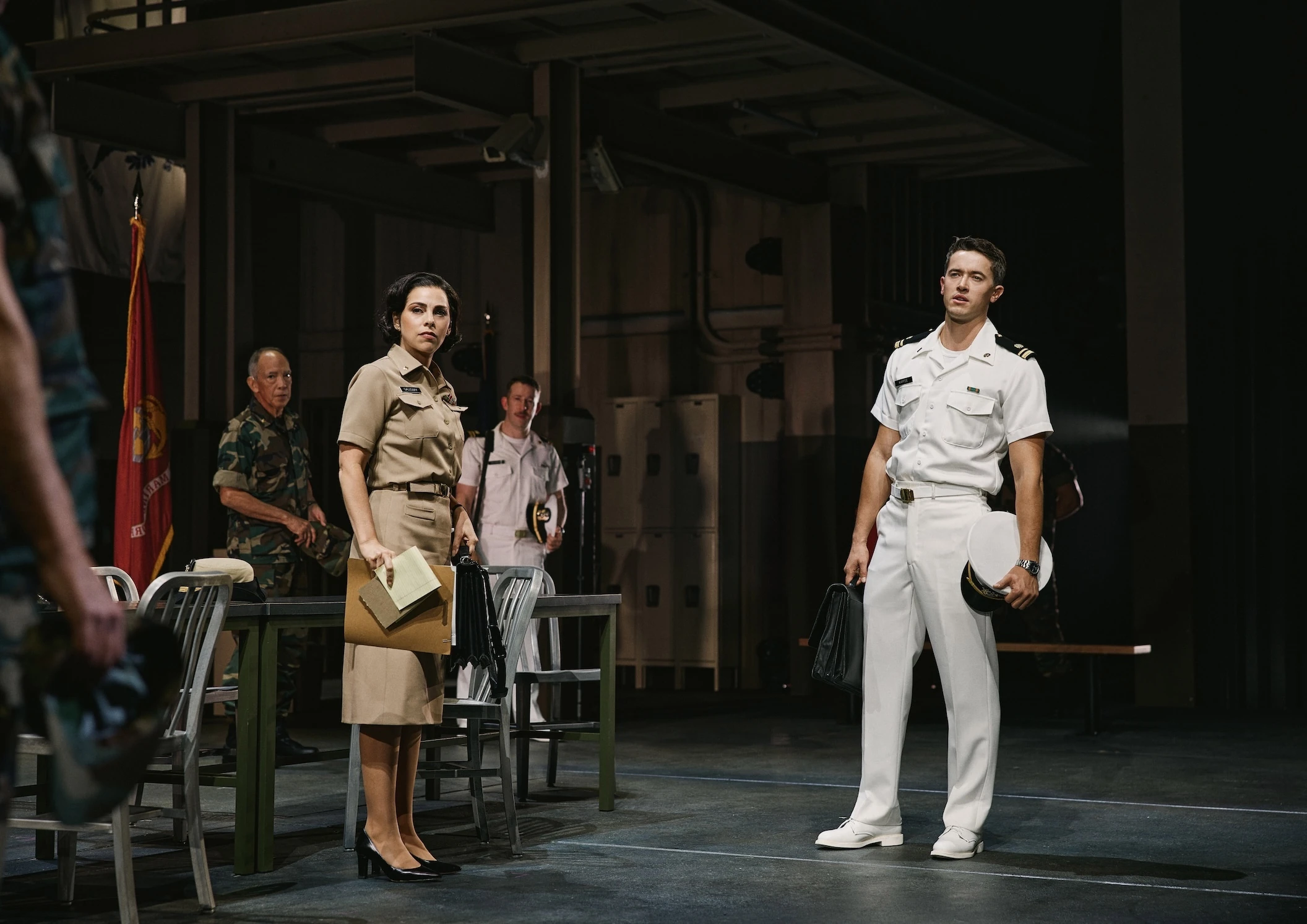
As the other two lawyers in the Kaffee klatsch, Krysta Rodriguez and Nick Blaemire do a fine job inhabiting the character types they’ve been assigned: she as Jo, an overeager beaver with spine beneath her spunk, and he as Sam, a brainy Jewish sidekick. Sorkin regular Bradley Whitford—who was a replacement Kaffee in A Few Good Men’s original production—has the harder task of competing with Nicholson’s indelible Jessep. It’s not a huge role, and it calls for a deeper menace than Whitford has mustered. Jessep believes he’s in “the business of saving lives,” and that those who don’t accept the brutality that this business requires—whether weaklings like the dead soldier or naive civilian moralists like the lawyers—are a menace to the country. Whitford captures his arrogance, but not his fearsome righteous conviction.
If it doesn’t shake us with at least the possibility that Jessep could be right, A Few Good Men loses its biggest claim to relevance. In his 1989 New York Times review, Frank Rich wondered if the fall of the Berlin Wall already made the show seem dated. Subsequent history, from the torture at Abu Ghraib to the cruelty of Donald Trump’s ICE machine, may have proved that judgment premature. But the issues raised by such incidents seem increasingly distant from the deep code of honor that Sorkin is exploring; it sometimes feels now as though, at the very highest levels of command, no honor is involved at all. The play’s glancing treatment of what it means to be a man—“Is your father proud of you?” Kaffee asks Sam in a moment of crisis—is still germane, but it’s thin; masculinity is being interrogated in more trenchant ways right now in plays like Degenerates, The Holes and Two Girls.
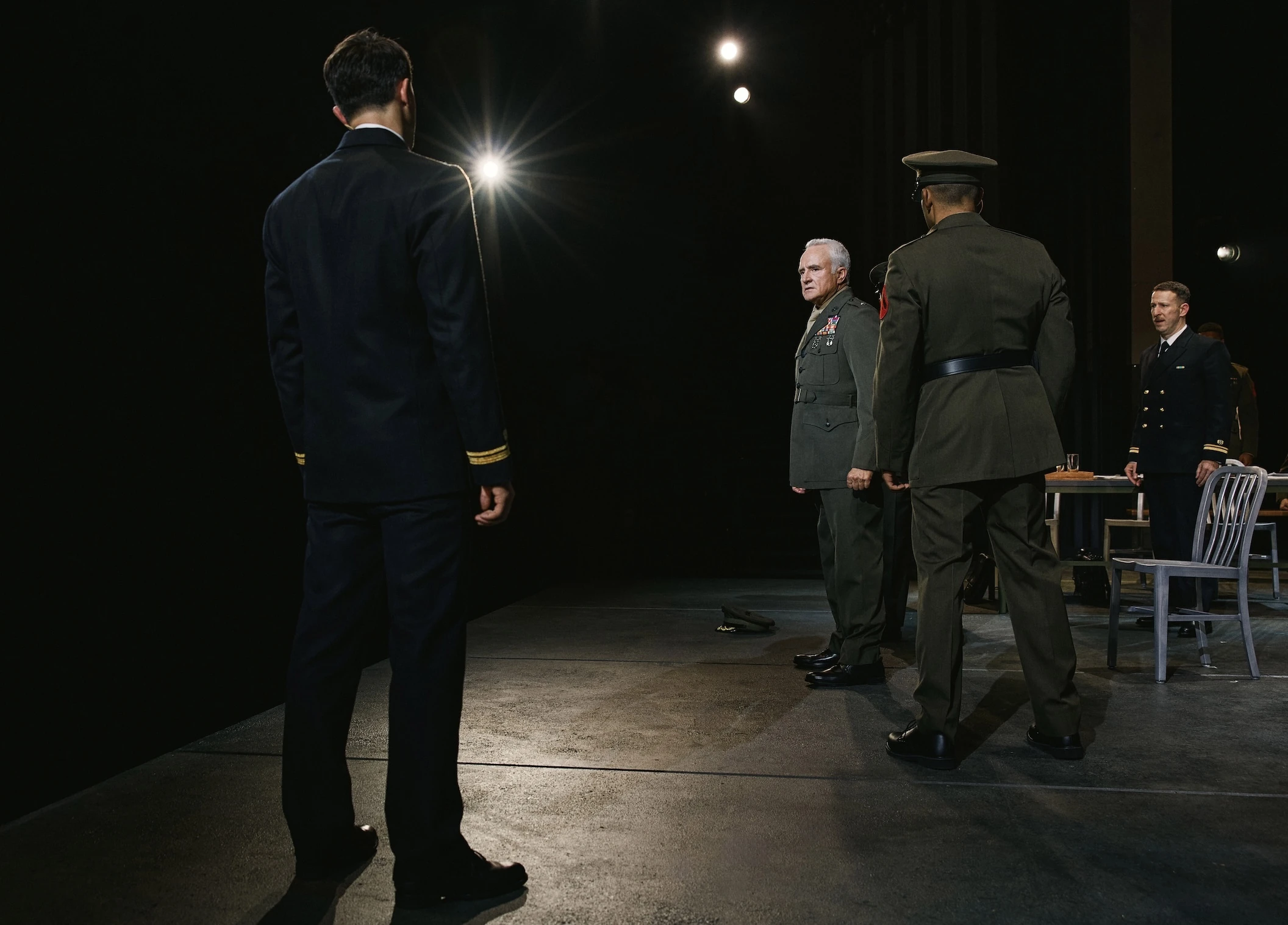
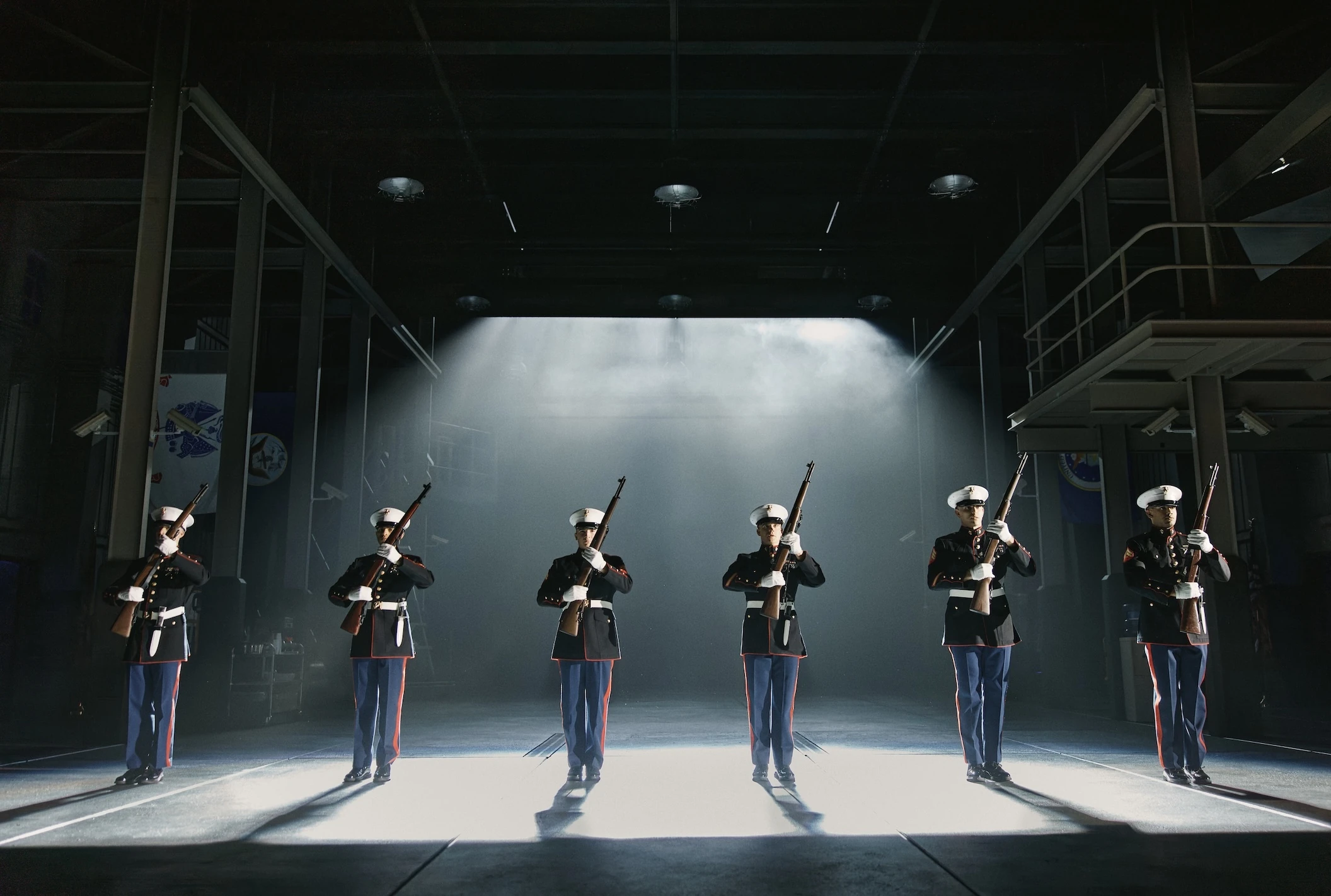
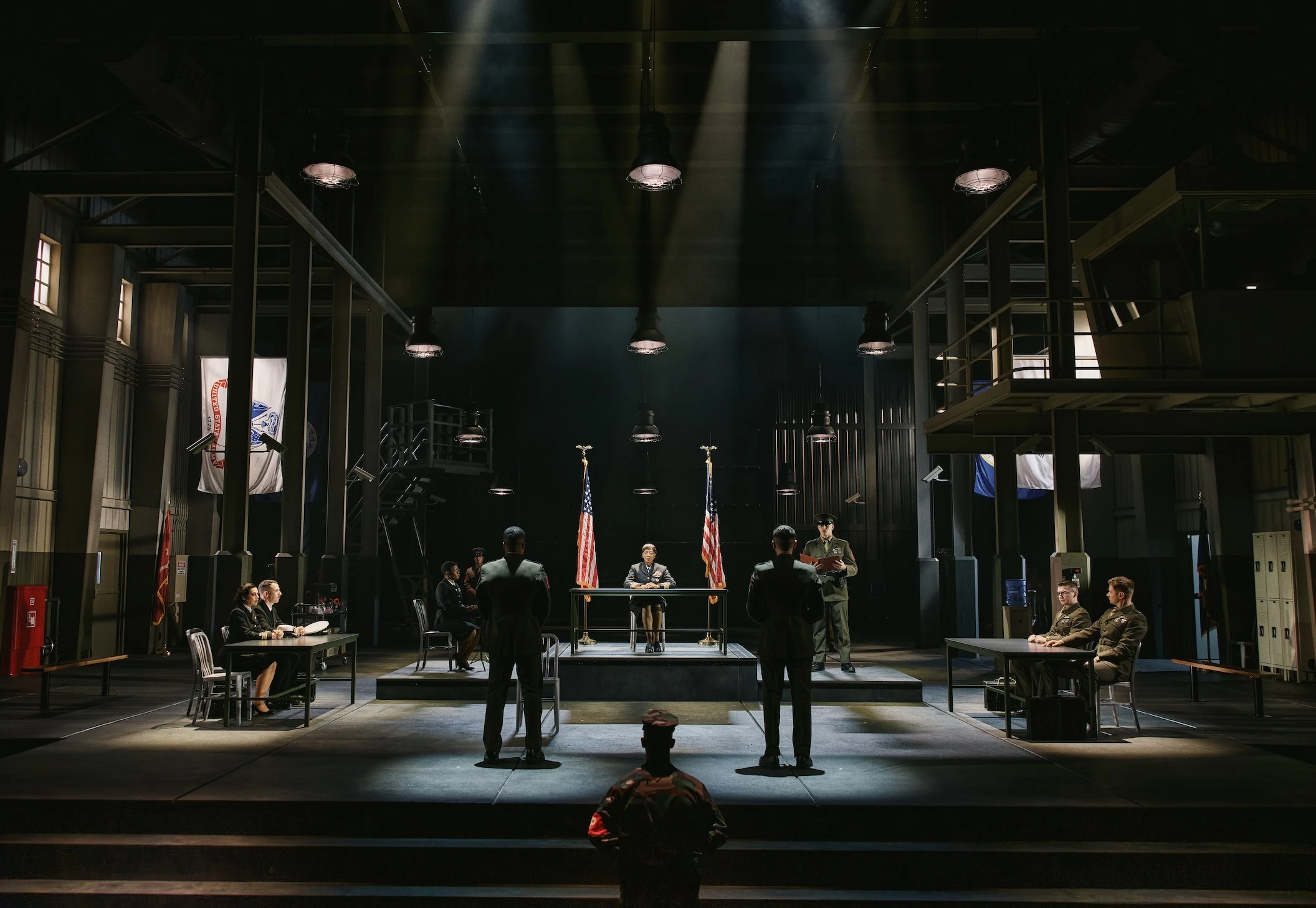
If A Few Good Men is thus less political than it looks, at least it looks good. Buttressed by set designer Dane Laffrey (Arden’s longtime creative partner) and lighting designer Japhy Weideman, Arden’s staging makes strong use of the Vivian Beaumont Theater’s deep playing space to achieve effects ranging from the cinematic—it begins with a signature Sorkin walk-and-talk scene!—to the monumental. And the huge cast, spiffily attired by Alejo Vietti, is uniformly good. Thom Sesma and John Zdrojeski play Jessep underlings of different stripes; Lavel Schley and Collin Kelly-Sordelet are the suitably stiff defendants; Michael Oberholtzer is the prosecutor, and Stephanie Berry is the judge (reimagined as a Black woman with an amusing hint of impatience with nonsense). The production may not generate much excitement, but it earns a respectful salute—the proper response to a show whose duties have been discharged honorably, if not with special distinction.
A Few Good Men. Vivian Beaumont Theater (Broadway). By Aaron Sorkin. Directed by Michael Arden. With Tom Blyth, Krysta Rodriguez, Bradley Whitford, Nick Blaemire, John Zdrojeski, Thom Sesma, Stephanie Berry, Michael Oberholtzer, Lavel Schley, Collin Kelly-Sordelet. Running time: 2hrs 30mins. One intermission.
Follow Adam Feldman on X: @FeldmanAdam
Follow Adam Feldman on Bluesky: @FeldmanAdam
Follow Adam Feldman on Threads: @adfeldman
Watch Time Out’s theater podcast on YouTube: Sitting Ovations
Follow Time Out Theater on X: @TimeOutTheater
Keep up with the latest news and reviews on our Time Out Theater Facebook page