

[title]
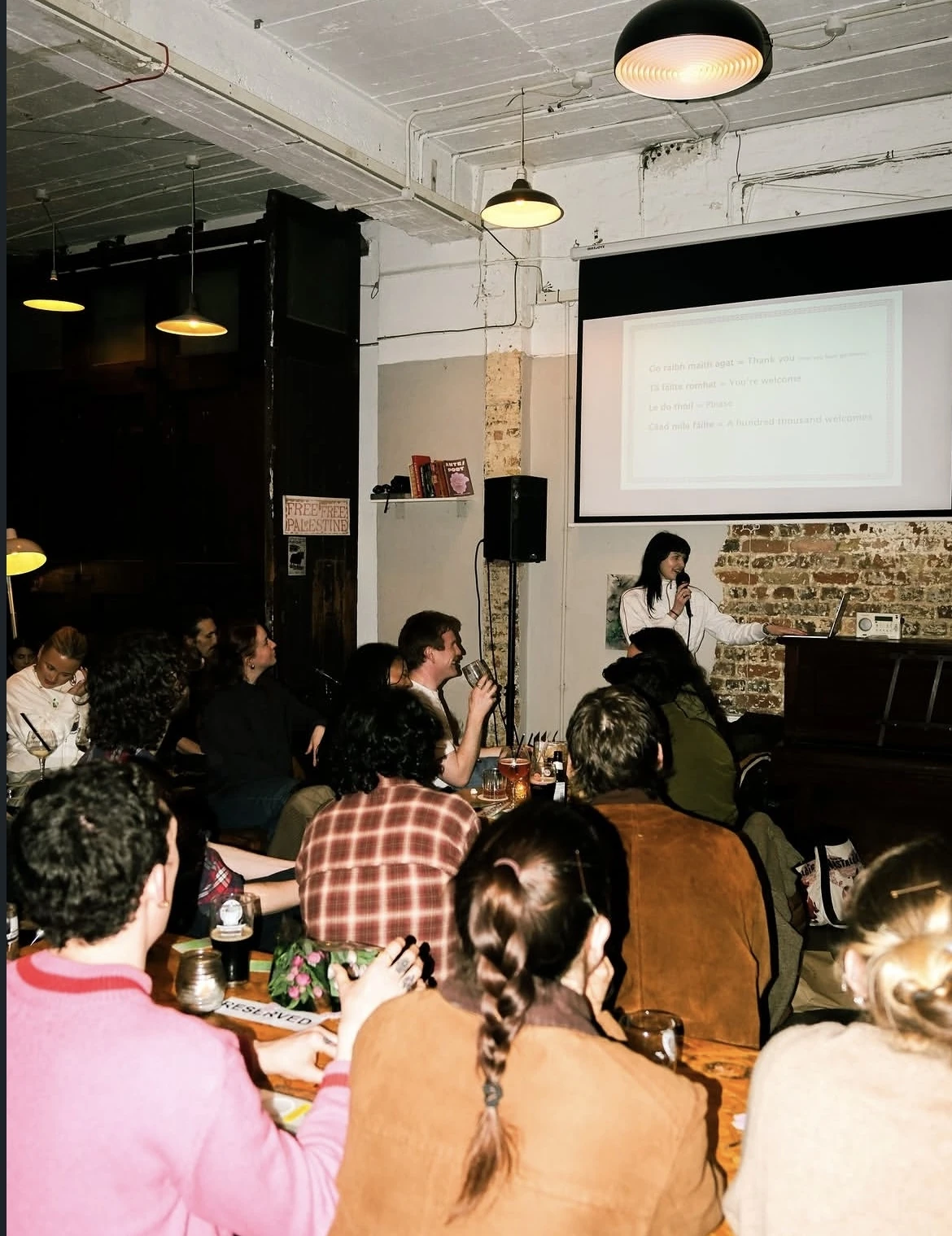
It’s a Wednesday evening and, officially, the venue is the Black Horse in Aldgate. Unofficially, however, it’s a patch of grass in a nearby park, because the football is on and has taken over the pub. So instead, there’s tinnies, glorious London sunshine and a scrappy semicircle of strangers learning how to order a pint of Guinness in both Irish and Bosnian. The event is billed as Oíche Ceilteach agus Balcánach, a Celtic and Balkan night with Irish and Bosnian classes for beginners, pay what you can with proceeds going to Ionad Hind Rajab, a humanitarian charity in Gaza.
There’s no grammar test here, no fear of getting caught out on ‘tá’ versus ‘bhí’, the present and past tense of ‘to be’ and one of the first things that trips up beginners. Just a group of twenty- and thirty-somethings sitting and chatting. Some grew up in Ireland speaking the language fluently. Some have Irish ancestry they’re trying to reconnect with. Some have no family tie to Ireland at all, just curiosity, or a recent trip that hooked them.
Meanwhile, a few miles over in Hammersmith, a class at the Irish Cultural Centre is so oversubscribed that spots vanish from a WhatsApp group within minutes of sign-ups opening. In the same building, 180 people turn up to a meditation class conducted in Irish, a language many of them don’t speak yet. Across town, a multi-million-pound rebuild is adding a cinema, a public library and London’s first dedicated Irish theatre to the London Irish Centre in Camden. Irish, it turns out, is having a moment, in pubs, in music, in classrooms and on meditation hall floors.
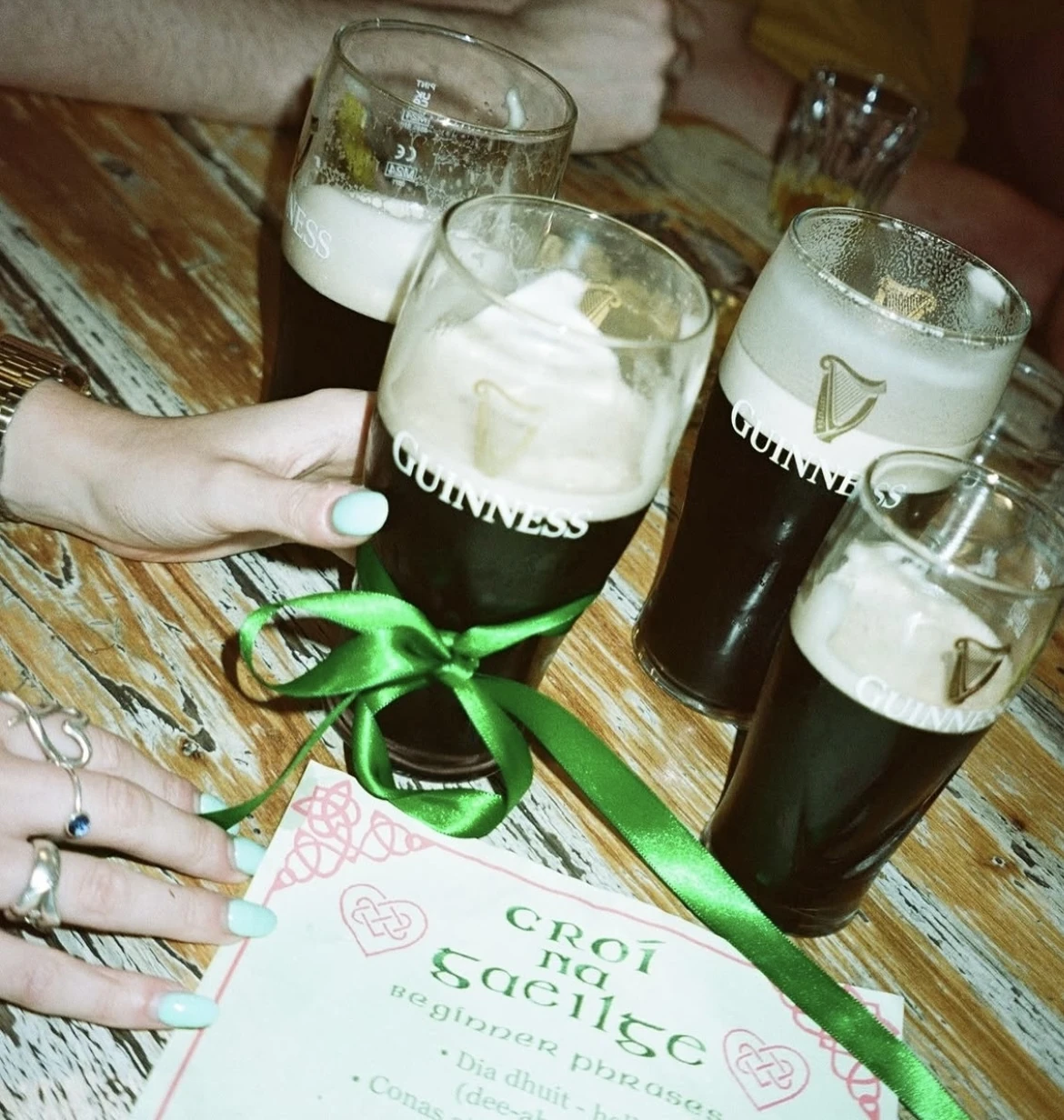
Croí na Gaeilge
The group behind the Black Horse event is Croí na Gaeilge, meaning ‘heart of Irish’. If you’re picturing a beige community hall with laminated vocab sheets, think again. This is a group that runs an Irish-speaking running club through Hyde Park and Victoria Park, hosts queer meet ups, and regularly gets Irish speakers together ahead of gigs by emerging Irish bands at The Lexington.
The gig meet ups make sense once you clock what’s happening to Irish culture more broadly. A 2026 Core Research survey found 60 percent of adults think Irishness has become more visible in recent years, naming acts like Fontaines D.C., CMAT and Dermot Kennedy as contributing influences. Kneecap’s FENIAN went to number two on the UK Official Albums Chart in May, and CMAT’s Euro-Country won best album at this year’s Ivor Novello Awards. Meanwhile Irish passport applications have been climbing since Brexit (an estimated six million Brits have at least one Irish grandparent). It stands to reason that a few of the newly minted nationals are heading to the classroom to learn the language.
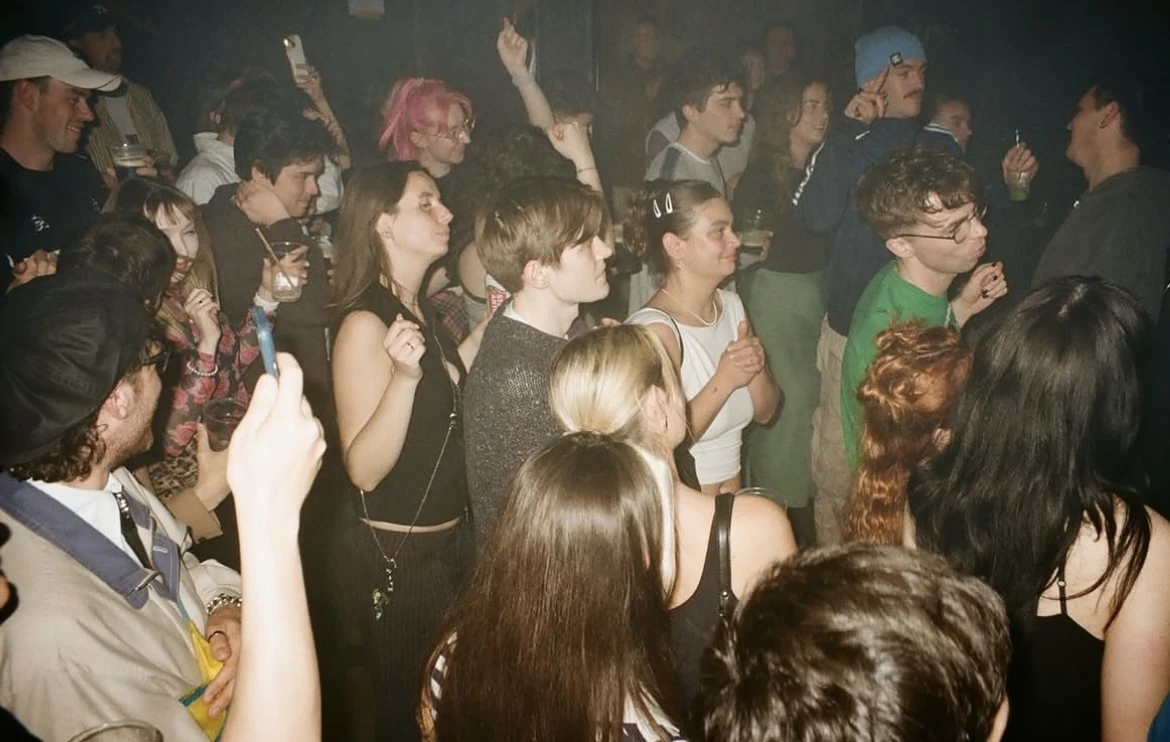
Croí na Gaeilge’s founder, Emily de Búrca, started young. She spent five consecutive summers on an Irish language course in the Gaeltacht, one of Ireland’s Irish-speaking regions, from the age of 13. ‘It was the first time in my life I felt like I could become the person I wanted to be,’ she says. ‘Probably one of the most pivotal points of my life.’
She moved to London in January 2023 and bagged a design studio job she thought was perfect. She ended up hating it. ‘So began my quarter life crisis, I guess,’ she says. Not long after, in the middle of another rough patch, she landed on the idea. ‘I was like, what’s important for me going forward? I love this language, I love people,’ she says. ‘I had to break down to break through.’
Her teacher at the Gaeltacht was none other than JJ Ó Dochartaigh, who now DJs (often in a balaclava) as one third of rap trio Kneecap, a group whose work includes explicit material on Palestinian suffering. She’s since bumped into him at a gig in Dalston and had ‘just a little hug in the mosh pit.’
Not the only room in town
At the Irish Cultural Centre in Hammersmith, Pádraig O’Loingsigh has been teaching a language class since the pandemic. An attempt at teaching over Teams during lockdown grew into an oversubscribed in-person class with a waiting list every term. It’s accredited through the University of Liverpool’s Institute of Irish Studies, an odd arrangement given the two are hundreds of miles apart. You don’t need to already be a university student to sign up and a full year costs £190. ‘A lot of people come through Duolingo, and then they try to join the classes,’ O’Loingsigh says. ‘But it’s very hard to get on. There are waiting lists.’
He teaches the whole class in Irish, working things out together in groups rather than sitting in silence. ‘I’m forcing people in the classes to speak,’ he says. ‘I’m not that interested in the written stuff.’ Through his own research at the University of Liverpool, he’s studied what he calls the myth of the ‘perfect speaker’, an imagined, judgemental figure learners feel they have to live up to, ‘a kind of godlike figure in the ether’, as he puts it. Forcing people to talk from day one is his way of getting past that fear before it takes hold.
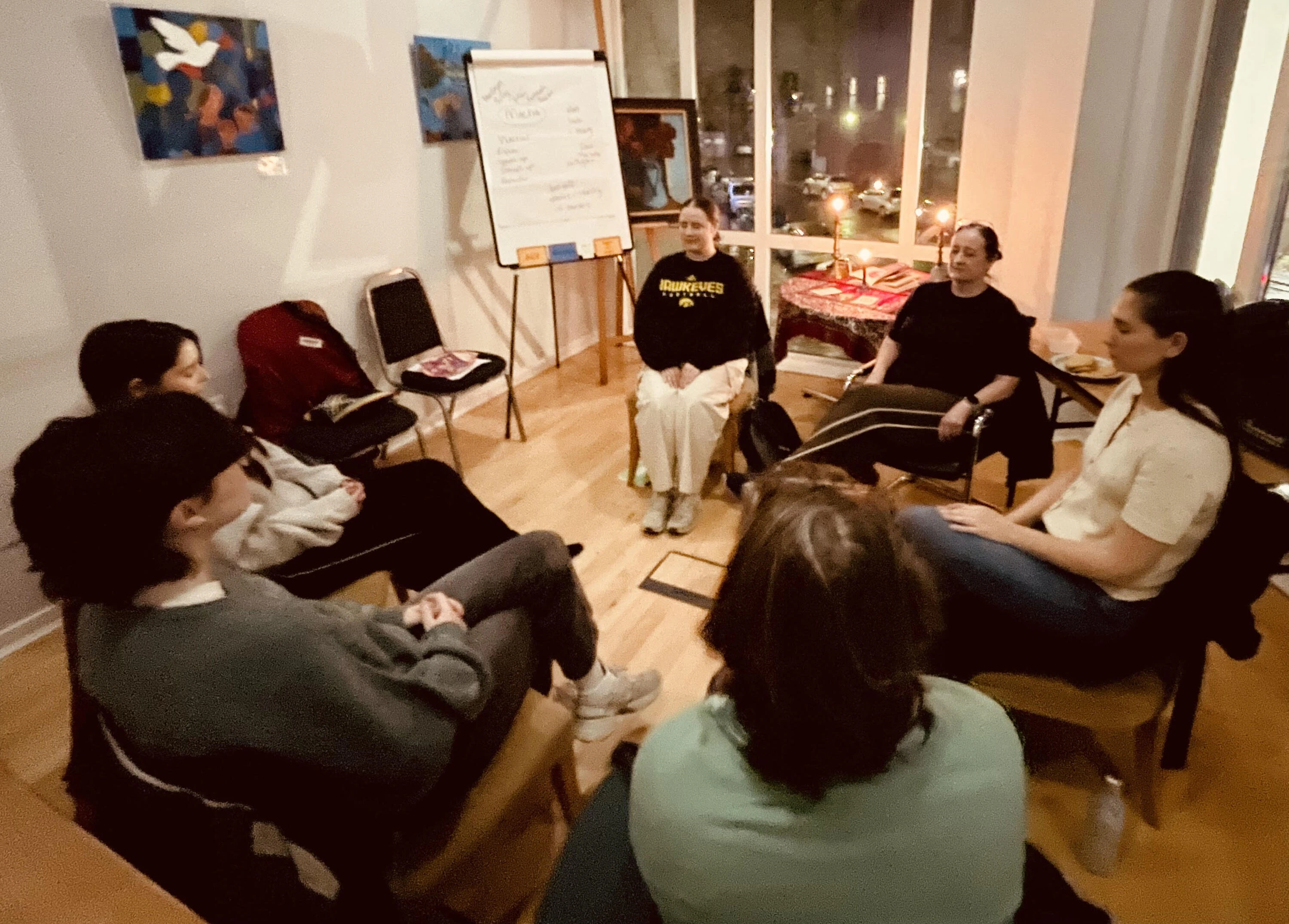
In the same building, Máire Ní Mhaolalaidh has spent the last two years developing a meditation practice out of pre-Christian Irish goddess mythology. Last month, 180 people sat cross legged on the floor of the main hall to be led through a meditation conducted in Irish. ‘That was quite incredible, to have 180 people in the main hall doing a meditation in ancient Irish,’ she says. ‘Almost like goosebumps.’ It started with 35 people in a small upstairs room back in November 2024.
Every phrase in the meditation is said in Irish, then translated into English straight after. Participants are guided by goddesses from pre-Christian Irish mythology, women like Ériu, the ancient goddess of sovereignty, the land and abundance, and the reason Ireland is called Éire. ‘I could not believe, from a feminist point of view, that the name of my own country was the name of an ancient goddess,’ Ní Mhaolalaidh says. ‘I have never been taught that.’
The demand isn’t isolated to any one class. Irish is now the second most-studied language on Duolingo within Ireland itself. The London Irish Centre has a waiting list of around 2,000 people, and its recent Scoil na Gaeilge course sold out in 24 hours. ‘It’s impossible to keep up with the demand,’ Rebecca Dorothy, the centre’s culture and education officer, told RTÉ. City Lit’s Irish enrolments are up 57 percent year on year. The centre’s £36 to 38 million Camden rebuild, adding a cinema, a public library and London’s first dedicated Irish theatre, is named explicitly within the Irish government’s own Diaspora Strategy for 2026 to 2030.
Who’s actually going?
Carter O’Sullivan works in the music industry with bands including Fontaines DC. His grandfather was born in Ireland before the family settled in England, and trips back for Christmas and New Year were a fixture of his childhood. Because of that, he’d always meant to actually learn the language. He tried Duolingo first and hated it, finding the app’s heavy reliance on reading and typing didn’t suit him as someone with dyslexia. ‘It wasn’t talking at me, and I wasn’t talking to it,’ he says. A Croí na Gaeilge meet up worked better. He turned up alone and found everyone else at his table had too. ‘It was very much, we’re all in this together.’
He’s got a lot more out of it than vocabulary. ‘I feel way more immersed in the narrative and the storytelling,’ he says of the music he already loved. ‘It’s given me power and identity to actually grasp onto these things.’
Dr Marc Scully, a social psychologist who’s spent two decades studying Irish identity in England, is careful not to call any of this unprecedented. ‘The obvious comparison point for me is the eighties,’ he says, of a London Irish identity where young people blended punk with the dance halls their parents had brought over. Now, the scale of access is different. People can build a relationship with contemporary Ireland online, and it’s easier to feel connected to a place you’ve never visited or lived in. Brexit gave people a practical reason to care as well as an emotional one. ‘People felt this sense of, I need to prove I’m not just doing it for the airport queues,’ he says.
He’s got a term for what draws in people with no Irish blood at all. ‘Affinity diaspora’, a felt sense of belonging that doesn’t run through ancestry. ‘It’s not unique to Irishness,’ he says. ‘People get quite aligned with K-pop, or with a football team from a city they’ve never visited.’
Back in the park by the Black Horse, nobody’s thinking about any of that. They’re just trying to work out how to order a second round in Irish.
Get the latest and greatest from the Big Smoke – from news and reviews to events and trends. Just follow our Time Out London WhatsApp channel.
Stay in the loop: sign up for our free Time Out London newsletter for the best of the city, straight to your inbox.