

[title]
★★★★★
Reviewing the actual Bayeux Tapestry feels like an undertaking of hysterical hubris: why not just review the Norman Conquest while you’re at it? The tapestry isn’t just a work of art: it is literal history, a near-1,000-year-old artefact that is also the primary source for our understanding of the most momentous year in the story of our own country.
I feel like I don’t really need to offer a lot of background for why the tapestry – woven in England, displayed in Bayeux, Normandy – has made it to the British Museum. Blah blah blah landmark Anglo-French deal, blah blah blah insanely popular: probably the most popular museum exhibition of our lifetimes. Now here it is.
Are we not so familiar with the tapestry already that seeing it in situ is a bit underwhelming? Honestly, not a bit of it. Photos of a few key moments in your school textbooks – Edward the Confessor on his throne, the appearance of Hailey’s Comet, Harold getting shot in the eye – maybe encompass its highlights in terms of the major historical talking points. But they scarcely touch on it as art. Laid out flat in one continuous 70 metre strip, the Bayeux Tapestry is astonishing, a heady mix of the familiar and the unfamiliar that teeters somewhere between outsider art, medieval illumination, action cartoon, historical document and blithe propaganda (it’s widely thought to have been commissioned by William the Conqueror’s half-brother Odo, who certainly pops up in it in a flattering light a suspicious number of times).
It tells a story, but it’s not a solemn or complicated one. In 1065, Edward sends Harold to France, for reasons that aren’t explained and therefore we genuinely don’t know. Harold is blown off course and captured. William rescues him, and together they team up and take down a guy called Conan, with Harold rescuing some of William’s men from quicksand along the way. Harold swears he’ll support William’s claim to the throne of England (he was Edward’s first cousin). Edward dies in January 1066, and Harold bagsies the kingship for himself. William is ticked off, the Normans invade, eventually battling Harold and the English army; Harold gets an arrow in the eye and that’s it: there was more to the tapestry but it’s been lost, though probably only a relatively small amount perhaps covering William’s coronation.
It’s extravagantly otherworldly
It is simple, even crude storytelling: metres on metres are taken up by boats and war horses – it’s boyishly excitable about the details of conflict, an action comic realised in millennium-old cloth.
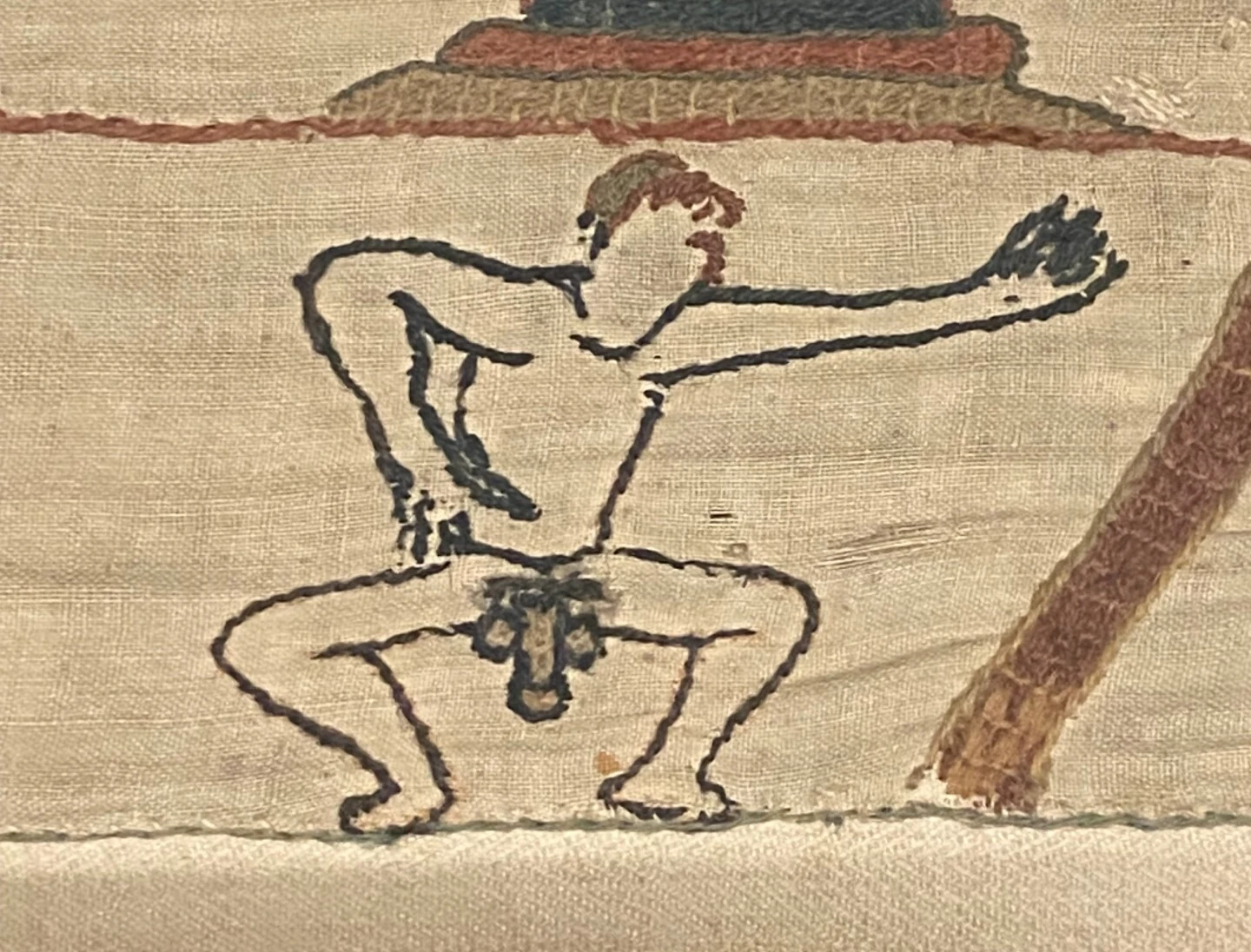
It’s accessible by dint of its simplicity. But it’s also extravagantly otherworldly, the story at the centre of the long, narrow tapestry topped and tailed by joyously random images of fantastical beasts and the odd weird naked guy – I counted at least two penises, which is definitely two more penises than I expected in the Bayeux Tapestry.
I mean really what the hell is this thing? I throw around comics and illuminations as reference points but I’m not really aware there’s much to compare the tapestry to – it both brings events that every English person has drilled into them since birth startlingly to life, but also confirms what a long time in the history of humanity a thousand years is. It is mad having it so tangibly there, being able to see the texture of the weaving. And yet the art is sometimes hilariously unrealistic: they can’t do horses; at one point a man dressed like a tower stands next to a tower that seems to be the same height as him; it is kind of like something my 11-year-old might draw but it is also an undertaking so enormous it’s hard to believe it exists. It is simply mind-blowing to have this ravening, unfiltered blast of Norman triumphalism right here in the room. Of course I was awed, but I chuckled, puzzled, tried to imagine the 11th century mind, failed.
So yeah it’s basically incredible and you should see it and let me flag up here that new tickets are being released on October 21 at 10am.
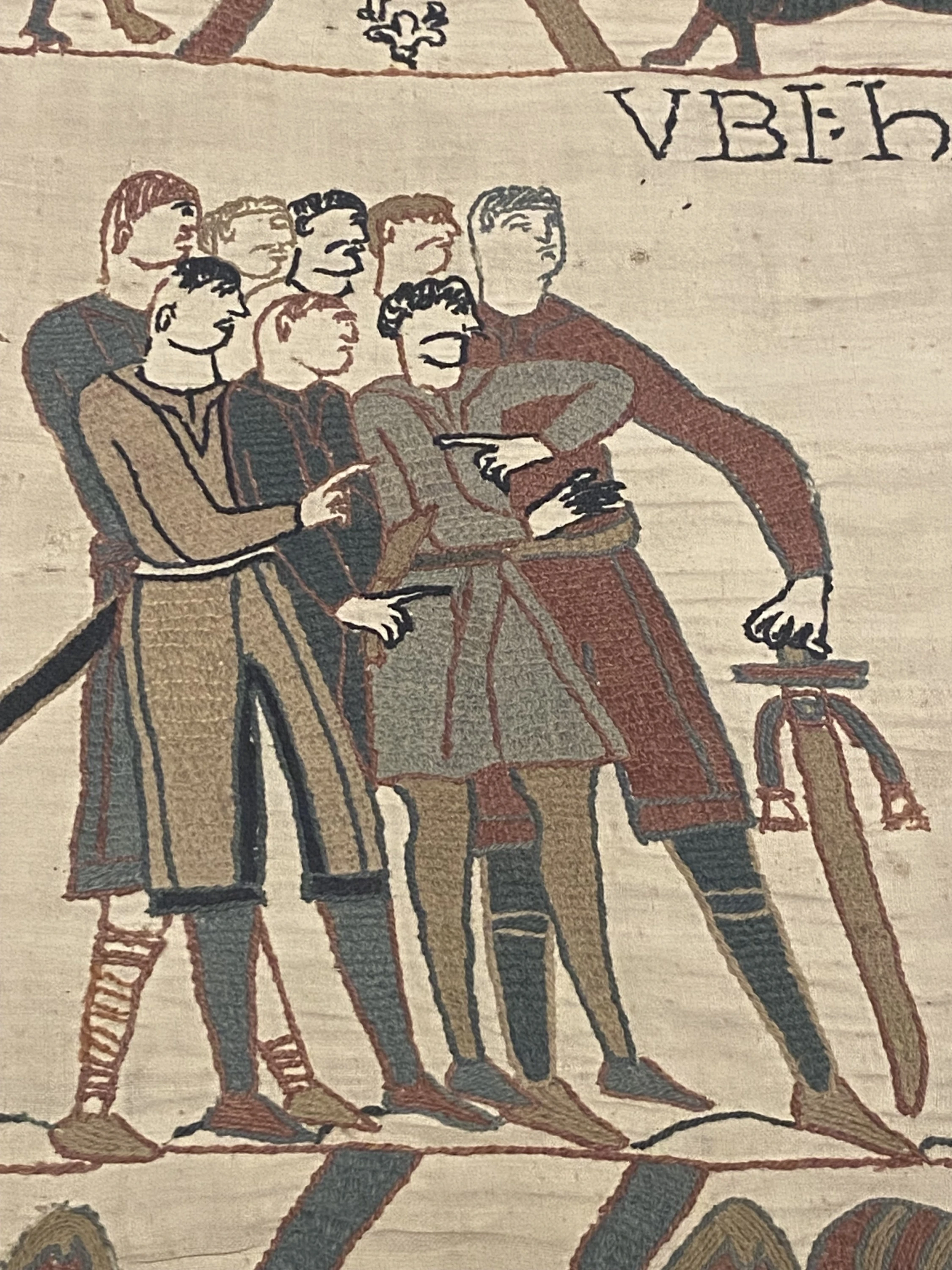
That’s me arrogantly reviewing the actual tapestry, which you could have seen in France anyway. In terms of this exhibition: we enter via a mezzanine floor in which screens offer some elegant animated preamble. Then we descend to the start of the tapestry, which is laid flat in one straight line. The lighting is dim but not suffocatingly so (I took plenty of photos). There is gentle mood music occasionally enlivened by sound effects (wood being chopped for instance). Another series of screens stretch the length of the tapestry and offer colloquial translations of its Latin captions, which move along its length in a way intended to keep crowds moving in tandem – you could get lost for days looking at every weird little animal on the tapestry, but the whole experience is supposed to be about 40 minutes.
I had some quibbles! It is really very light on context for a British Museum show. It could have dug far deeper into the historical background of England and Normandy in the 11th century. And I’d have liked some more nuts and bolts stuff about the tapestry itself: I don’t exactly understand how it has come to be preserved so remarkably. But I suspect that it’s intentionally quite a slick, frictionless experience to stop audiences getting bogged down. And keeping the focus on the tapestry itself makes sense: it’s one of the most famous objects ever and it’s bloody enormous – let’s unapologetically drink the whole thing in and do the reading after.
Of course it’s ultimately above criticism. But it’s also extraordinary: sacred, profane, childish, profound, defining of our world but utterly unworldly. Odo, you did alright.
The Bayeux Tapestry opens at the British Museum from September 10 2026 until Jul 11 2027. The next batch of tickets is released Oct 21.
The top 10 art exhibitions in London.
Andy Burnham reveals the three London pubs he’ll always love.
Get the latest and greatest from the Big Smoke – from news and reviews to events and trends. Just follow our Time Out London WhatsApp channel.
Stay in the loop: sign up for our free Time Out London newsletter for the best of the city, straight to your inbox.